 Written by
 Hijama (Wet Cupping): How It Works, the Science, and Top Benefits
An old therapy making a modern comeback — here’s what actually happens during a session, what research says, and who should think twice before trying it.
| Also known as | Wet cupping |
|---|---|
| Origins | Ancient Egypt, Greece, China, and Islamic tradition |
| Main types | Dry, wet, moving, and fire cupping |
| Commonly used for | Circulation, pain relief, stress, and general wellness |
| Status | A complementary therapy, not a replacement for medical treatment |
What Hijama Is
Hijama involves placing cups on specific areas of the body to create suction; in wet cupping, small superficial incisions follow the initial suction, drawing out a small amount of blood believed to carry “stagnant” or waste material with it. The word comes from Arabic, meaning “to suck,” with strong roots in prophetic medicine — though cupping itself appears across Chinese, Egyptian, and Greek traditions too.
Most people describe the sensation as tight pressure rather than pain, often reporting feeling lighter afterward. The goal, as practitioners describe it, isn’t blood loss — it’s clearing what’s believed to be blocked circulation so the body can function more efficiently.
A Brief History
Cupping is one of the oldest documented medical treatments — the Ebers Papyrus (around 1550 BCE) describes ancient Egyptians using it for fever, pain, and menstrual imbalances. Hippocrates later recommended it in Greek medicine, while traditional Chinese medicine used it to balance “Qi,” or energy flow.
Islamic tradition gave Hijama specifically its cultural and spiritual weight through its mention in prophetic teachings. As pharmaceutical medicine rose, traditional therapies like this one faded in many places — until renewed interest in complementary, natural approaches brought it back into view.
Why It’s Popular Again
Modern life brings processed food, pollution, chronic stress, and long hours of sitting — conditions the body wasn’t built to handle continuously. That’s driven interest in therapies framed as a “reset,” alongside growing visibility from athletes and public figures showing off cupping marks after crediting it for faster recovery.
Frustration with over-reliance on medication plays a role too — many people are looking for complementary approaches that work alongside the body rather than only masking symptoms.
How It Works
A practitioner places cups on specific points — often the back, shoulders, or neck — using a manual pump or heat to create suction, which pulls skin upward and increases local blood flow. The cup is removed, small superficial incisions are made, and it’s reapplied to draw out a small amount of blood.
Beyond the physical mechanism, suction stimulates nerve endings, which some believe triggers the release of endorphins — the body’s natural painkillers — alongside effects on circulation and the lymphatic system.
The Science Behind It
Some research has explored a “detoxification effect,” with certain studies suggesting the blood drawn during wet cupping contains higher concentrations of specific waste products compared to regular venous blood — prompting interest in its effect on oxidative stress. Other research points to improved microcirculation, where localized blood vessel expansion may reduce muscle tension and tissue stiffness.
Pain relief is the most studied area, often explained through the “gate control theory,” where stimulating certain nerve fibers may reduce pain signals reaching the brain. Even so, larger, higher-quality studies are still needed — Hijama is best understood as a complementary therapy, not a replacement for medical treatment.
| Technique | Main Purpose | Blood Removal |
|---|---|---|
| Dry Cupping | Muscle tension relief | No |
| Wet Cupping (Hijama) | Detox & circulation boost | Yes |
| Moving Cupping | Massage & mobility | No |
| Fire Cupping | Deep suction therapy | Sometimes |
Dry cupping uses suction only, moving cupping combines oil and gentle movement for a massage-like effect, and fire cupping uses heat to create suction before placement. A trained practitioner should assess individual needs before recommending which technique fits.
Top Benefits
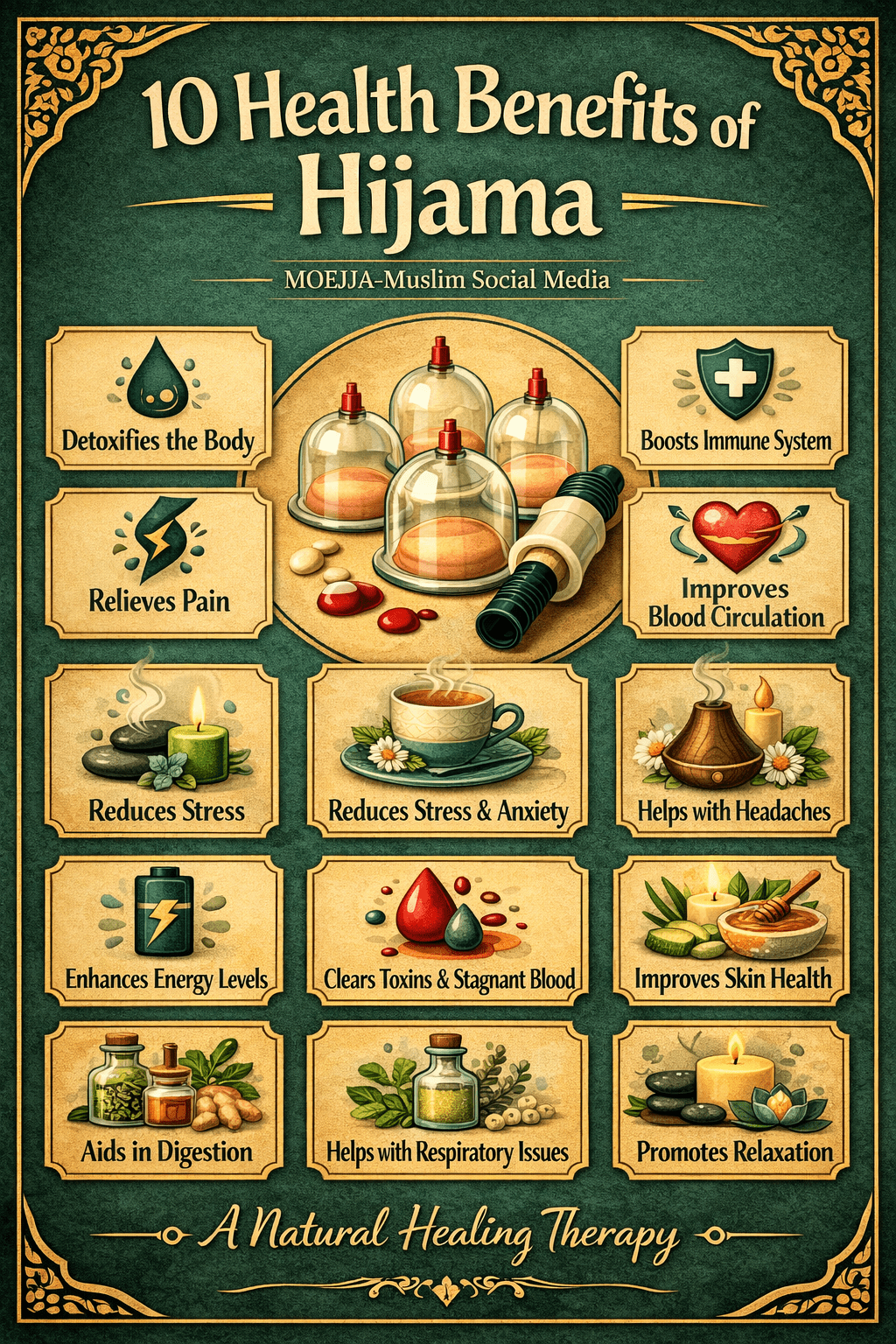
1Improves Blood Circulation
Suction pulls blood toward the surface, potentially supporting oxygen delivery, muscle recovery, and reduced inflammation.
2Supports the Body’s Detox Process
May stimulate circulation and lymphatic flow, working alongside — not instead of — the liver, kidneys, and other natural detox pathways.
3Relieves Chronic Pain
Commonly used for lower back pain, shoulder tension, and migraines, potentially via reduced muscle tension and endorphin release.
4Reduces Stress & Anxiety
May stimulate the parasympathetic (“rest and digest”) nervous system, with many describing a deep sense of relaxation during sessions.
5Supports the Immune System
Some research points to changes in immune markers after sessions, though this works best alongside sleep, nutrition, and hydration — not as a replacement for them.
The Bottom Line
Hijama is a natural, complementary therapy with a long history and some genuinely promising early research — not a replacement for medical care. Anyone considering it should see a qualified, hygienic practitioner, and people with severe anemia, bleeding disorders, or who are pregnant should speak with a healthcare provider first.
Frequently Asked Questions
Is Hijama painful?
Most people describe Hijama as mildly uncomfortable rather than painful. The suction creates pressure, and the small incisions are usually superficial.
How often should you do Hijama?
Frequency varies depending on individual health needs. Some people do it monthly, while others may schedule sessions a few times a year.
Are there any side effects?
Temporary redness, mild soreness, or bruising may occur. Serious side effects are rare when performed by trained professionals.
Who should avoid Hijama?
People with severe anemia, bleeding disorders, or those who are pregnant should consult a healthcare provider before considering Hijama.
How long does it take to feel results?
Some individuals feel immediate relief, while others notice gradual improvements over a few days.
Contact
Available for contract work involving WordPress development, SEO/AEO, and digital marketing.
- LocationKhulna, Bangladesh
- Websitemahadi.moejja.com
- Platformmoejja.com
- WhatsAppMessage on WhatsApp