 Written by
 The Six Kalemas: Text, Meaning, and Why They Matter
Six short formulas that cover belief, praise, repentance, and rejection of disbelief — here’s what each one actually says, and what it asks of a believer.
| Kalema Tayyiba | The core declaration of faith — belief in Allah and Muhammad’s prophethood |
|---|---|
| Kalema Shahadat | The fuller testimony of faith, affirming Allah’s oneness and dominion |
| Kalema Tamjeed | Praise, glorification, and acknowledgment of Allah’s greatness |
| Kalema Tauheed | A focused declaration of Allah’s absolute oneness |
| Kalema Astaghfar | A plea for forgiveness, known and unknown sins alike |
| Kalema Radde Kufr | A rejection of disbelief and renewal of commitment to Islam |
What Kalema Actually Means
Kalema simply means “word” or “statement” in Arabic. In everyday Islamic usage, it most often refers to a specific declaration — the testimony of faith — but the term also covers six related formulas that together touch on belief, praise, repentance, and the rejection of disbelief.
What makes it more than a phrase is what it’s meant to do: mark the boundary between belief and disbelief, shape daily worship, and function as something recited at the very start and very end of a Muslim’s life. It’s short enough to memorize in a sentence and consequential enough to define an entire framework of faith.
The Belief It Encodes
Theologically, the core Kalema breaks into two parts: negation and affirmation. “La ilaha illallah” negates any claim to divinity besides Allah; “Muhammadur Rasulullah” affirms Muhammad as His messenger. Together they form the Shahadah — the basic creed that separates a believer from a non-believer in Islamic terms.
This structure is meant to eliminate shirk (associating partners with Allah) at the root, rather than addressing it case by case. Reciting it once marks entry into Islam; living by it consistently is treated as a separate, ongoing commitment rather than a box checked at the outset.
The Six Kalemas
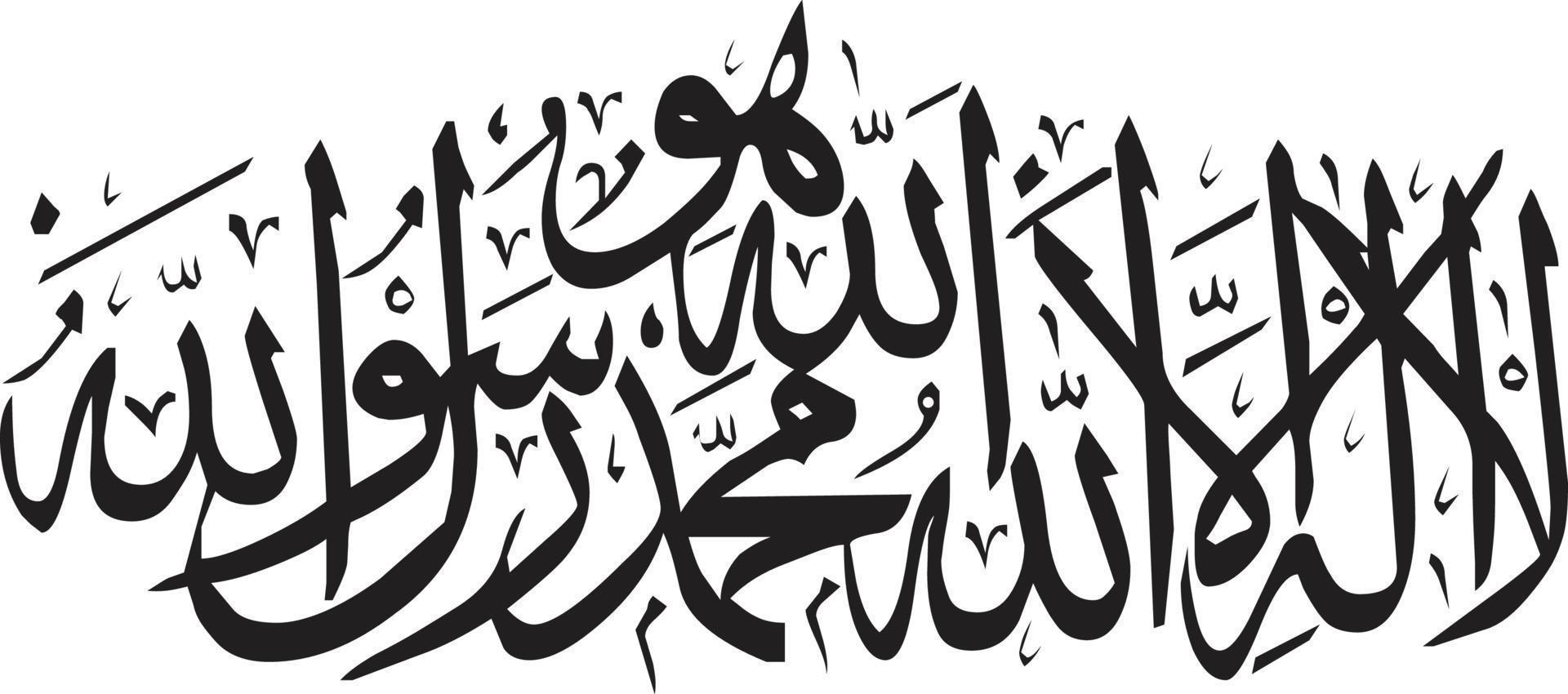
1. Kalema Tayyiba — The Pure Word
لَا إِلٰهَ إِلَّا اللّٰهُ مُحَمَّدٌ رَّسُولُ اللّٰهِ
La ilaha illallah, Muhammadur Rasulullah
“There is no god but Allah; Muhammad is the Messenger of Allah.”
This is the first thing most Muslim children learn and the phrase at the center of the faith — a two-part declaration of Allah’s oneness and Muhammad’s prophethood. It’s described in tradition as the most excellent form of remembrance, less a sentence to memorize than a lens the rest of belief gets viewed through.
2. Kalema Shahadat — The Testimony of Faith
أَشْهَدُ أَنْ لَا إِلٰهَ إِلَّا اللّٰهُ وَحْدَهُ لَا شَرِيكَ لَهُ لَهُ الْمُلْكُ وَلَهُ الْحَمْدُ يُحْيِي وَيُمِيتُ وَهُوَ حَيٌّ لَا يَمُوتُ أَبَدًا أَبَدًا ذُو الْجَلَالِ وَالْإِكْرَامِ بِيَدِهِ الْخَيْرُ وَهُوَ عَلَى كُلِّ شَيْءٍ قَدِيرٌ، وَأَشْهَدُ أَنَّ مُحَمَّدًا عَبْدُهُ وَرَسُولُهُ
“I bear witness that there is no god but Allah, alone, without partner. His is the dominion and all praise; He gives life and causes death, and He is ever-living, never dying. Possessor of majesty and honor, in His hand is all good, and He has power over all things. And I bear witness that Muhammad is His servant and messenger.”
This expands the first Kalema into a fuller testimony, formally marking someone’s entry into Islam when recited with sincere belief. It’s the same declaration recited by Muslims of every nationality and language — one of the more concrete expressions of the faith’s claimed universality.
3. Kalema Tamjeed — The Word of Glory
سُبْحَانَ اللّٰهِ وَالْحَمْدُ لِلّٰهِ وَلَا إِلٰهَ إِلَّا اللّٰهُ وَاللّٰهُ أَكْبَرُ وَلَا حَوْلَ وَلَا قُوَّةَ إِلَّا بِاللّٰهِ الْعَلِيِّ الْعَظِيمِ
“Glory be to Allah, and all praise be to Allah. There is no god but Allah, and Allah is the Greatest. There is no power and no strength except with Allah, the Most High, the Most Great.”
This one functions as a compact form of dhikr, combining praise, glorification, magnification, and surrender to divine will in a single short formula. Recited with reflection rather than rushed through, it’s generally described as steadying — a shift away from immediate stress toward something more grounded.
4. Kalema Tauheed — The Word of Oneness
لَا إِلٰهَ إِلَّا اللّٰهُ وَحْدَهُ لَا شَرِيكَ لَهُ لَهُ الْمُلْكُ وَلَهُ الْحَمْدُ يُحْيِي وَيُمِيتُ وَهُوَ حَيٌّ لَا يَمُوتُ أَبَدًا أَبَدًا ذُو الْجَلَالِ وَالْإِكْرَامِ بِيَدِهِ الْخَيْرُ وَهُوَ عَلَى كُلِّ شَيْءٍ قَدِيرٌ
“There is no god but Allah, alone, without partner. His is the dominion, and to Him belongs all praise. He gives life and causes death, and He is ever-living, never dying. Possessor of majesty and honor, in His hand is all good, and He has power over all things.”
This shares much of its text with the Shahadat but is treated as a focused statement on Tawheed specifically — a direct rejection of any shared divinity or authority alongside Allah. It’s often framed as the intellectual backbone separating Islamic monotheism from both polytheistic and purely secular worldviews.
5. Kalema Astaghfar — The Word of Forgiveness
أَسْتَغْفِرُ اللّٰهَ رَبِّي مِنْ كُلِّ ذَنْبٍ أَذْنَبْتُهُ عَمْدًا أَوْ خَطَأً سِرًّا أَوْ عَلَانِيَةً وَأَتُوبُ إِلَيْهِ مِنَ الذَّنْبِ الَّذِي أَعْلَمُ وَمِنَ الذَّنْبِ الَّذِي لَا أَعْلَمُ إِنَّكَ أَنْتَ عَلَّامُ الْغُيُوبِ وَسَتَّارُ الْعُيُوبِ وَغَفَّارُ الذُّنُوبِ وَلَا حَوْلَ وَلَا قُوَّةَ إِلَّا بِاللّٰهِ الْعَلِيِّ الْعَظِيمِ
“I seek forgiveness from Allah, my Lord, from every sin I have committed, knowingly or unknowingly, secretly or openly. I turn to Him in repentance for the sin I am aware of and the sin I am unaware of. Indeed, You are the Knower of the unseen, the Concealer of faults, the Forgiver of sins. There is no power and no strength except with Allah, the Most High, the Most Great.”
This one addresses a plain fact of being human — that mistakes happen, some noticed and some not. It’s a direct plea for pardon rather than a declaration of belief, and it’s paired with a broader teaching that Allah’s forgiveness remains genuinely open, no matter how far someone feels they’ve drifted.
6. Kalema Radde Kufr — The Word of Rejection of Disbelief
اللّٰهُمَّ إِنِّي أَعُوذُ بِكَ مِنْ أَنْ أُشْرِكَ بِكَ شَيْئًا وَأَنَا أَعْلَمُ بِهِ وَأَسْتَغْفِرُكَ لِمَا لَا أَعْلَمُ بِهِ تُبْتُ عَنْهُ وَتَبَرَّأْتُ مِنَ الْكُفْرِ وَالشِّرْكِ وَالْكِذْبِ وَالْغِيبَةِ وَالْبِدْعَةِ وَالنَّمِيمَةِ وَالْفَوَاحِشِ وَالْبُهْتَانِ وَالْمَعَاصِي كُلِّهَا وَأَسْلَمْتُ وَأَقُولُ لَا إِلٰهَ إِلَّا اللّٰهُ مُحَمَّدٌ رَّسُولُ اللّٰهِ
“O Allah, I seek refuge in You from knowingly associating anything with You, and I seek Your forgiveness for what I do unknowingly. I repent from it, and I disassociate myself from disbelief, association with You, falsehood, backbiting, innovation, slander, indecency, false accusation, and all sin. I submit to You, and I say: there is no god but Allah, Muhammad is the Messenger of Allah.”
This functions as a broader renewal — not just addressing personal sin, but explicitly disowning a fairly wide list of behaviors incompatible with sincere belief. It’s less about a single lapse and more about periodically resetting one’s overall spiritual orientation.
Its Role in Daily Worship
The core Kalema shows up throughout the day in practice, not just as an abstract belief — recited within the call to prayer, repeated during the Tashahhud portion of Salah, and traditionally circled back to during Hajj alongside the Talbiyah. It’s also the phrase tradition holds should ideally be someone’s final words, tying the beginning and end of a Muslim’s life to the same declaration.
Outside formal ritual, it shapes ordinary conduct too — a reminder, in the middle of daily pressures, that ultimate control and outcome rest beyond one’s own effort. That framing is meant to encourage humility in success and steadiness during hardship, rather than functioning only as a formula recited at fixed moments.
Common Misunderstandings
The most common one is treating the Kalema as a one-time formality — something spoken once at conversion and then set aside. It’s better understood as the start of an ongoing commitment, one that’s meant to keep shaping conduct rather than being filed away as completed.
A related misunderstanding separates belief from behavior entirely, as though reciting the words alone guarantees an outcome regardless of how someone actually lives. Tradition treats belief and action as connected — genuine conviction is expected to show up in honesty, humility, and how people treat each other, not just in what’s spoken.
Building It Into Daily Life
Practically, this tends to look like small, repeated habits rather than one dramatic moment — a quiet recitation at the start and end of the day, during a stressful moment, or in a supplication. None of it requires elaborate ritual; the emphasis throughout is on sincerity and consistency over scale.
Teaching it to children usually works better through explanation and example than rote memorization alone — connecting the words to everyday moments like gratitude before a meal or patience during a setback, so the phrase means something concrete rather than becoming background noise recited without thought.
Frequently Asked Questions
What does the word Kalema mean?
It simply means “word” or “statement” in Arabic. In Islamic usage it refers specifically to the declaration of faith and, more broadly, to the six formulas covering belief, praise, repentance, and rejection of disbelief.
How many Kalemas are there?
Six: Kalema Tayyiba, Kalema Shahadat, Kalema Tamjeed, Kalema Tauheed, Kalema Astaghfar, and Kalema Radde Kufr — each serving a distinct purpose, from the core declaration of faith to seeking forgiveness.
Why is the first Kalema considered the foundation of Islam?
Because it contains the two-part declaration — belief in one God and acceptance of Muhammad as His messenger — that formally marks someone’s entry into Islam. Every other practice is built on that foundation.
Does reciting the Kalema once guarantee salvation regardless of behavior?
No. It’s understood as the beginning of a lifelong commitment, not a one-time formality — belief is expected to show up consistently in conduct, not just be spoken once and set aside.
How can someone build the Kalema into daily life?
Through regular remembrance (dhikr), reciting it during difficulty or gratitude, including it in daily supplications, and teaching its meaning to children rather than treating it as something to memorize without understanding.
The Bottom Line
Six short formulas, but between them they cover most of what belief is asked to do in daily life — declare faith, offer praise, admit fault, and periodically reset one’s orientation when it drifts. None of them are complicated to memorize; living by what they actually ask is the part that takes an entire lifetime rather than a single recitation.
Contact
Available for contract work involving WordPress development, SEO/AEO, and digital marketing.
- LocationKhulna, Bangladesh
- Websitemahadi.moejja.com
- Platformmoejja.com
- WhatsAppMessage on WhatsApp