 Written by
 SEO and AEO in 2026: What Bloggers Need to Know
Google no longer just ranks pages — it synthesizes answers. Here’s what actually moves the needle for bloggers now.
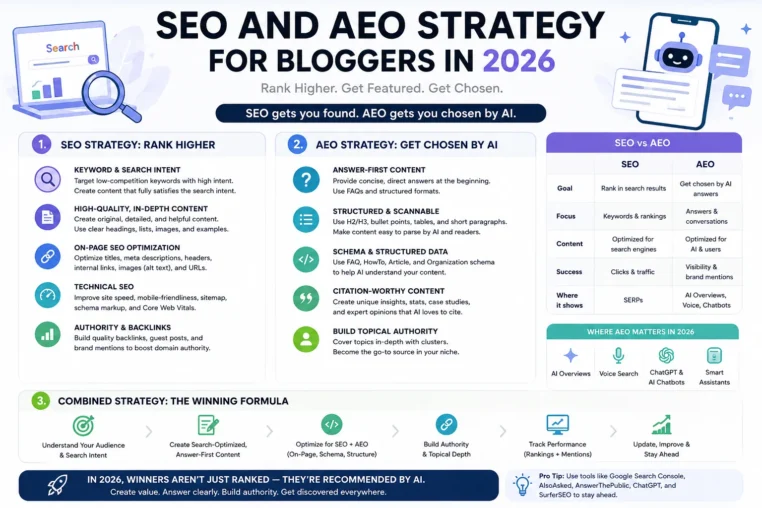
| SEO optimizes for | Search rankings and clicks |
|---|---|
| AEO optimizes for | AI-generated answers and citations |
| Biggest 2026 signal | E-E-A-T — Experience, Expertise, Authority, Trust |
| Content update cycle | Review high performers every 6–12 months |
| What AI rewards most | Clear, structured, genuinely human writing |
Search has changed. Dramatically. A few years ago, ranking on Google mostly meant writing keyword-focused content, getting backlinks, and hoping your page hit the top three results. That world still exists — sort of — but 2026 is different. Now AI systems like Google AI Overviews, ChatGPT, Gemini, and Perplexity are deciding which sources deserve visibility, and a lot of bloggers still haven’t adjusted.
If your content isn’t optimized for both traditional search engines and AI answer engines, your traffic can quietly disappear even while your rankings look “fine.” That’s the uncomfortable truth.
TL;DR — What Bloggers Need to Know in 2026
Quick Summary
- SEO alone is no longer enough — AEO (Answer Engine Optimization) matters just as much
- Google AI Overviews pull direct answers from highly structured, trustworthy content
- Bloggers focused only on keywords are losing visibility to entity-rich, experience-driven content
- E-E-A-T, topical authority, structured formatting, and direct answers matter more than ever
- AI search rewards clarity, credibility, and content that sounds genuinely human
Google no longer just ranks pages — it synthesizes information. That changes everything.
What Is SEO in 2026?
SEO in 2026 still means optimizing content to rank in search engines, but the signals have evolved far beyond keyword placement. Today’s SEO revolves around search intent matching, user engagement, entity relevance, experience-based content, brand authority, AI-readable formatting, trust signals, and semantic relationships.
Around 2021–2022, a 1,500-word article stuffed with keywords could still rank. That approach is dead now — Google’s systems have become very good at identifying shallow content, analyzing context, topical depth, and whether an article actually sounds like someone who knows the subject firsthand. Helpful, people-first content with strong E-E-A-T signals remains essential for visibility in AI-enhanced search.
What Is AEO (Answer Engine Optimization)?
AEO stands for Answer Engine Optimization. Instead of optimizing only for rankings, AEO focuses on helping AI systems extract, summarize, and cite your content directly inside answer engines — Google AI Overviews, ChatGPT search, Perplexity, Gemini, voice assistants, and conversational search tools.
A page can rank #1 organically and still lose clicks because an AI Overview answers the query before a user ever scrolls down. That’s why bloggers need visibility inside the answer itself, not just beneath it.
SEO vs. AEO: What’s the Difference?
| SEO | AEO |
|---|---|
| Optimizes for rankings | Optimizes for AI-generated answers |
| Focuses on keywords | Focuses on entities + context |
| Targets clicks | Targets citations + visibility |
| Traditional SERPs | AI Overviews, voice, chat search |
| Backlinks heavily weighted | Trust, clarity, structure heavily weighted |
| User visits your page | AI may summarize your page |
SEO is not dying — people saying “SEO is dead” every six months are usually trying to sell a course. What’s happening is an evolution: SEO and AEO now work together, and you need both.
Why Bloggers Are Struggling With AI Search
Most blogs were built for old-school search engines, not conversational AI systems. AI models prefer clear answers, structured headings, experience-driven writing, trustworthy sources, natural language, concise explanations, topic completeness, and schema markup. A generic article that rambles for 800 words before answering the question? AI systems hate that.
The Biggest SEO and AEO Ranking Factors in 2026
1E-E-A-T Is No Longer Optional
Google keeps reinforcing Experience, Expertise, Authoritativeness, and Trustworthiness — and AI search has doubled down on it. If content looks anonymous, generic, or mass-produced, AI systems become hesitant to surface it, especially in finance, health, legal, technology, and business. Bloggers need real author bios, visible expertise, citations, updated content, and authentic voice. Content with strong, informed opinions often performs better now because it sounds more human.
2Direct Answers Win More Visibility
AI systems love extractable answers: short summaries, bullet points, definitions, numbered steps, tables, and FAQ sections.
Weaker
“SEO is a broad discipline involving many optimization techniques…”
Stronger
“SEO in 2026 focuses on search intent, authority, structured content, and AI-readable formatting.”
Short. Clear. Quotable. AI loves quotable.
3Entity SEO Matters More Than Keywords
Google increasingly understands topics through entities and relationships, not isolated keywords. For a topic like “SEO and AEO,” relevant entities might include AI Overviews, structured data, semantic search, E-E-A-T, schema markup, topical authority, and content clusters. Modern optimization is about building topic depth, not gaming keyword density.
4Topical Authority Beats Random Blogging
A lot of bloggers publish disconnected articles — productivity apps one day, crypto the next, then dog food, then AI prompts. Google struggles to trust websites without topical consistency. A blog that deeply covers a connected cluster of subjects builds topical authority, and that authority compounds over time.
How Bloggers Should Structure Content in 2026
A practical structure that works well for both SEO and AEO:
Opening
- Direct answer intro
- TL;DR summary
- Human hook or story
Body & Close
- Question-based H2s
- Concise answers before details
- Lists, tables, and FAQs
- Schema markup + author bio
Simple. But powerful. Most people overcomplicate this.
The Rise of AI Overviews and Zero-Click Searches
Google increasingly answers queries directly in search — AI Overviews, zero-click searches, generative summaries. Yes, these reduce traffic for some informational content. But the nuance most people miss: visibility inside AI summaries still builds authority, brand familiarity, trust, and downstream clicks.
If someone repeatedly sees a brand cited in AI answers about a topic, that brand becomes mentally associated with expertise — and that matters more than people realize.
How to Optimize Blog Posts for AI Overviews
Question-Based Headings
AI systems frequently pull content from “What is…”, “How does…”, “Why does…” style headings, mirroring how humans ask questions conversationally.
FAQ Sections
Help with voice search, featured snippets, schema eligibility, and conversational AI extraction — Google explicitly rewards structured answer formatting.
Schema Markup
Article, FAQPage, HowTo, Breadcrumb, and Organization schema help machines understand context faster — and in AI search, machine understanding is everything.
Keep Content Updated
Freshness matters more now since AI systems prioritize current information. Updating stats, formatting, and examples can create outsized visibility gains.
Human Content Beats Generic AI Content
The internet is drowning in AI-generated sludge — generic summaries, predictable structures, empty advice. Users are tired of it, and search engines know it. This is why human texture matters so much: personal observations, mistakes, opinions, weird specifics, stories, practical insight.
AEO Writing Tips Bloggers Should Start Using Immediately
Write to a Smart Friend
Not a search engine, not an algorithm — a real person. That subtle shift changes your tone dramatically.
Add Micro-Experiences
Instead of “SEO requires patience,” try: “I’ve seen bloggers quit after three months because they expected instant traffic.” One sounds generic. One sounds lived-in.
Use Conversational Transitions
Phrases like “Here’s the thing…” or “This surprises people…” help content feel human. AI systems seem to trust conversational clarity more than stiff corporate writing.
Common SEO and AEO Mistakes Bloggers Still Make
Watch For
- Publishing thin content — a 700-word article that barely scratches the topic won’t compete
- Ignoring internal linking, which supports crawlability and topical authority
- Overusing AI without editing — readers and search systems can both feel it
- Chasing exact-match keywords instead of matching real search intent
The Future of Blogging in the AI Search Era
Blogging is not dying. Lazy blogging is dying. There’s a difference. The bloggers who survive 2026 are the ones who build authority, create genuinely useful content, embrace AI search, and sound unmistakably human — because that’s what AI systems increasingly reward.
The more advanced search becomes, the more human your content needs to feel.
Practical SEO + AEO Checklist for Bloggers in 2026
Before publishing any article:
SEO Essentials
- Primary keyword in title and H1
- Strong meta description
- Internal links added
- Optimized images
- Fast-loading, mobile-friendly pages
AEO Essentials
- Direct answer intro
- FAQ section
- Structured, question-based headings
- Schema markup
- Entity-rich, experience-based writing
Final Thoughts: SEO and AEO Now Work Together
You’re no longer just writing for search engines. You’re writing for AI systems, voice assistants, summaries, snippets, conversational interfaces, and humans, simultaneously. That sounds intimidating at first, but the winning formula is surprisingly simple: be clear, be helpful, be structured, be trustworthy, and sound real. In a world flooded with synthetic content, authenticity becomes a ranking advantage — probably the most important SEO lesson of 2026.
Frequently Asked Questions
What is the difference between SEO and AEO?
SEO focuses on improving visibility in traditional search rankings, while AEO focuses on optimizing content so AI systems and answer engines can extract and summarize it directly in experiences like Google AI Overviews and ChatGPT.
Is SEO still important in 2026?
Yes. SEO remains essential but now works alongside AEO — rankings still matter for traffic, authority, and indexing, while AEO helps content appear inside AI-generated answers.
How do bloggers optimize for AI Overviews?
Use concise answers, structured headings, FAQ sections, schema markup, and strong E-E-A-T signals. AI systems prefer content that’s clear, trustworthy, easy to summarize, and experience-driven.
What is AEO content writing?
Creating articles optimized for AI extraction and conversational answers — direct responses, semantic structure, natural language, FAQs, and highly readable formatting.
Will AI replace blogging?
No. AI is changing how blogs are discovered, but human expertise, originality, storytelling, and firsthand experience are becoming even more valuable.
Does keyword density still matter in 2026?
Not nearly as much as before. Search engines focus more on intent, entities, semantic relevance, and topical authority than forced keyword repetition.
Are backlinks still important for SEO?
Yes. High-quality backlinks remain a major authority signal, though trust, experience, engagement, and AI readability now play a much larger role alongside them.
How often should bloggers update content?
High-performing articles should ideally be reviewed every 6–12 months — updating examples, statistics, internal links, and formatting improves both SEO and AI Overview visibility.
Can AI-generated content rank on Google?
Yes, if it’s genuinely useful, accurate, edited by humans, and demonstrates expertise. Purely generic AI content without originality or trust signals struggles much more in 2026.
Contact
Available for contract work involving WordPress development, SEO/AEO, and digital marketing.
- LocationKhulna, Bangladesh
- Websitemahadi.moejja.com
- Platformmoejja.com
- WhatsAppMessage on WhatsApp