 Written by
 SEO Score Rank Math: 20 Proven Ways to Improve Your Content
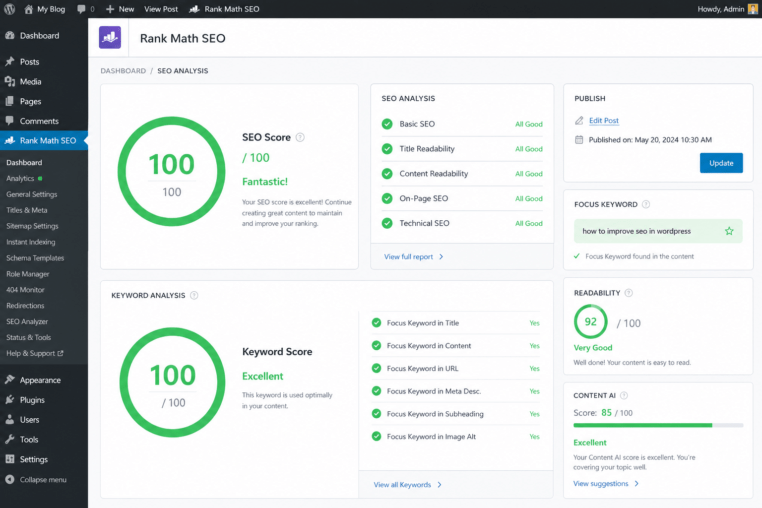
A high Rank Math score isn’t about gaming a plugin — it’s about building content search engines and readers genuinely find valuable.
| What it is | An on-page optimization checklist, not a Google ranking score |
|---|---|
| Good score range | 80–100, but usefulness matters more than the number |
| What it checks | Keyword placement, meta tags, headings, links, images, schema |
| What it can’t measure | Search intent, expertise, backlinks, website authority |
| Golden rule | Write for readers first, optimize second |
Have you ever finished a great blog post only to see a disappointing 58/100 in Rank Math? Most bloggers have. The writing itself is often solid — the article simply misses a few on-page optimization signals. A handful of strategic fixes can jump a score from 58 to 92, and more importantly, start attracting consistent organic traffic.
Rank Math isn’t trying to predict Google’s algorithm — it’s reminding you about SEO best practices that are easy to overlook.
What Is Rank Math SEO Score?
It’s an optimization score that evaluates whether your content follows common on-page SEO recommendations — not a Google ranking score, but a way to catch missing SEO elements before publishing. Think of it as a pre-flight checklist: a plane can still fly with a missing item, but pilots use one because small details matter.
What It Checks
Keyword placement, meta title and description, URL structure, headings, internal and external links, ALT text, content length, readability, and schema.
Why It Helps
Many checks align with modern SEO best practices — clear headings, comprehensive content, internal linking, and structured data.
Does a 100/100 Score Guarantee Rankings?
No — and this surprises many new bloggers. Google evaluates hundreds of signals that a plugin score simply can’t measure.
| Keyword placement | Google also weighs search intent |
|---|---|
| Meta optimization | Google also weighs helpful content |
| Internal links | Google also weighs backlinks |
| Readability | Google also weighs user engagement |
| Content length | Google also weighs experience & expertise |
| Schema | Google also weighs website authority |
An article scoring 86 with original screenshots and real examples usually earns more backlinks, longer reading time, and shares than one scoring 100 that just repeats what’s already everywhere.
Why Bloggers Should Still Care
Catches Forgotten Elements
We’ve all forgotten a meta description or internal link — Rank Math reminds you before publishing.
Improves Consistency
When every article follows the same checklist, your site becomes easier for search engines to crawl.
Supports AI-Era Search
AI assistants increasingly rely on well-structured content with clear headings and schema markup.
20 Ways to Improve Your Score — Part 1
1Choose the Right Focus Keyword
Pick the phrase that matches what your audience actually searches for, not just the highest search volume.
2Put the Keyword Near the Beginning of Your Title
Clearer, easier to scan, and tells readers immediately what they’ll learn.
3Write an Engaging Meta Description
Doesn’t directly boost rankings but improves click-through rate — promise value, not just a topic.
4Use One Clear H1
One H1, logical H2s, supporting H3s — a clean hierarchy helps both readers and search engines.
5Answer Search Intent Immediately
Give the answer first, then explain — this is exactly how featured snippets extract information.
6Write Comprehensive, Not Just Long, Content
A concise 1,500-word guide that answers every important question beats a padded 3,000-word article.
7Add Internal Links That Help Readers
Aim for 3–5 relevant links per article using descriptive anchor text instead of “click here.”
8Include High-Quality External References
Link only when it adds value — official documentation, respected publications, or academic sources.
9Optimize Your Images
Descriptive file names, relevant ALT text, compression, and modern formats like WebP.
10Write Better ALT Text
Describe the image as if to someone who can’t see it — never stuff keywords unnaturally.
20 Ways to Improve Your Score — Part 2
11Improve Readability
Short paragraphs, clear headings, bullet points, tables, and white space keep readers engaged.
12Use Schema Markup
Article for standard posts, FAQ for common questions, HowTo for tutorials — Rank Math makes this easy.
13Answer Questions Early
Skip the suspense — answering immediately increases the chance of appearing in featured snippets.
14Keep Your URL Clean
A simple, short URL is easier to remember, share, and for search engines to interpret.
15Write Better Titles
Include the primary keyword naturally, promise a clear benefit, and stay under roughly 60 characters.
16Update Older Articles
Refresh statistics, screenshots, broken links, and outdated advice every few months.
17Avoid Keyword Stuffing
Use related terms naturally — search engines understand semantic relationships well today.
18Focus on Search Intent First
People search for answers, not keywords — ask what problem the reader is trying to solve.
19Don’t Chase 100/100
If reaching a higher score means awkward repetition, stop — readers always come first.
20Publish, Measure, and Improve
Monitor impressions and CTR after publishing, then update weak sections and expand what works.
Common Rank Math Mistakes Bloggers Make
Avoid These
- Obsessing over achieving 100/100
- Repeating keywords unnaturally
- Ignoring search intent
- Writing only for the plugin instead of readers
- Publishing thin content
- Forgetting internal links
- Using generic image alt text
- Skipping schema markup
The plugin should guide your optimization — not control your writing.
Quick SEO Score Rank Math Checklist
| Title & Structure | Focus keyword in title, one H1, clear H2 headings |
|---|---|
| Content | Helpful introduction, comprehensive coverage |
| Links | Internal links and external references included |
| Images | Optimized files, alt text added |
| Technical | Schema enabled, meta description written, mobile-friendly |
If you can confidently tick every box, you’re already ahead of many new bloggers.
People Also Ask
1Does Rank Math SEO Score affect Google rankings?
Not directly. Google doesn’t use the score as a ranking factor — it checks whether content follows widely accepted on-page best practices.
2What is a good Rank Math SEO Score?
For most bloggers, 80–100 is considered excellent — though being helpful and original matters more than hitting 100.
3Why is my Rank Math score low?
Often a missing focus keyword, short content, no internal links, missing meta description, or weak heading structure.
4Should I always aim for 100/100?
Not necessarily — a high-80s or 90s score with natural writing beats a perfect score with forced keyword repetition.
Final Thoughts
Don’t write for Rank Math. Write for your readers. Use the plugin as a helpful checklist, not the final judge of your content. Some of the highest-performing articles on the web don’t have a perfect optimization score — they rank because they answer questions thoroughly and keep readers engaged. When strong writing meets thoughtful optimization, higher rankings often follow naturally.
Frequently Asked Questions
How many keywords should I use in Rank Math?
Focus on one primary keyword and naturally include related phrases throughout the article. Avoid stuffing keywords simply to increase your optimization score.
Can I rank with an SEO score below 80?
Yes. Many high-ranking pages have scores below 80 because Google evaluates overall usefulness, expertise, and relevance, not just plugin recommendations.
Does content length improve Rank Math scores?
Longer articles often earn higher scores because they naturally cover more optimization opportunities. However, length alone doesn’t improve rankings — quality always comes first.
Should every article include schema markup?
Whenever applicable, yes. Article schema is recommended for blog posts, while FAQ or HowTo schema can improve search visibility when they accurately reflect the page content.
How often should I update blog posts?
Review your highest-performing articles every 6–12 months. Refresh outdated information, improve internal links, add new examples, and update screenshots where necessary.
Contact
Available for contract work involving WordPress development, SEO/AEO, and digital marketing.
- LocationKhulna, Bangladesh
- Websitemahadi.moejja.com
- Platformmoejja.com
- WhatsAppMessage on WhatsApp