 Written by
 Saddam Hussein: Rise, Rule, and the Debate Over His Legacy
From a poor village near Tikrit to more than two decades ruling Iraq — a leader whose legacy still splits historians between modernizer and dictator.
| Born | April 28, 1937, Al-Awja, near Tikrit, Iraq |
|---|---|
| Ruled | 1979–2003, as Iraq’s fifth president |
| Party | Arab Socialist Ba’ath Party |
| Major conflicts | Iran-Iraq War, the Gulf War, the 2003 Iraq War |
| Died | Executed by hanging, December 30, 2006 |
Who He Was
Saddam Hussein Abd al-Majid al-Tikriti was born into poverty — his father disappeared before his birth, and his early years were marked by instability rather than privilege. As a teenager, he became drawn to Arab nationalism and joined the Arab Socialist Ba’ath Party, a decision that would shape both his life and Iraq’s future.
Rise to Power
The Ba’ath Party promoted Arab unity, socialism, and nationalism during a period of coups and political turmoil in Iraq. In 1959, Saddam took part in a failed assassination attempt against Prime Minister Abd al-Karim Qasim and fled into exile — an experience many historians see as shaping his later belief that political survival required absolute control.
When the Ba’ath Party returned to power in 1968, Saddam steadily built influence behind the scenes — controlling security services, managing intelligence networks, and building loyalty within the military. By the time President Ahmed Hassan al-Bakr resigned in July 1979, Saddam was already widely seen as Iraq’s real power broker; he became president within days and launched a purge of suspected rivals almost immediately.
Iraq Under His Rule
Oil revenues surged through the 1970s, and the government invested heavily across several sectors:
| Area | Major Investments |
|---|---|
| Education | Free schooling and literacy campaigns |
| Healthcare | Expanded hospitals and medical services |
| Infrastructure | Roads, bridges, and public projects |
| Housing | New residential developments |
| Industry | State-owned industrial expansion |
Alongside that modernization, political freedom narrowed sharply. The government relied on secret police, surveillance, political arrests, and censorship — critics, journalists, and opposition figures faced serious consequences, and many Iraqis learned to avoid discussing politics in public.
The Iran-Iraq War
In September 1980, Saddam invaded Iran — driven by border disputes, regional power competition, and fear that Iran’s Islamic Revolution might spread into Iraq. Iraqi leaders expected a quick victory; instead, the war dragged on for eight years, becoming one of the longest and bloodiest conflicts of the twentieth century, with casualty estimates ranging from hundreds of thousands to over a million people.
Rather than emerging stronger, Iraq came out of the war with massive debts and deep economic strain — a turning point many analysts see as fundamentally reshaping the country’s trajectory.
The Gulf War
In August 1990, Saddam invaded Kuwait, accusing it of overproducing oil and damaging Iraq’s economy. The international community condemned the move, and a U.S.-led coalition assembled to expel Iraqi forces. Operation Desert Storm, launched in early 1991, lasted only weeks before Iraqi forces withdrew.
Saddam remained in power, but Iraq faced severe sanctions, economic hardship, and international isolation — the prosperity of the 1970s was gone, replaced by a period increasingly defined by economic struggle.
The Sanctions Era
Throughout the 1990s, international sanctions limited trade and economic activity, leading to shortages of medicine, food, and consumer goods for ordinary Iraqis. Meanwhile, the government maintained tight control over political life — a combination of hardship and authoritarian governance that shaped an entire generation.
The 2003 Invasion & Capture
After the September 11 attacks, tensions between Iraq and the United States intensified, with the Bush administration citing alleged weapons of mass destruction as justification for military action. Coalition forces invaded in March 2003, and Baghdad fell within weeks — Saddam’s statue being pulled down on April 9, 2003, became a symbolic image of the regime’s collapse.
Saddam remained hidden for months amid constant rumors, until U.S. forces found him near Tikrit on December 13, 2003, hiding in an underground space widely referred to as a “spider hole” — images that shocked the world and marked one of the defining moments of the war.
Trial & Death
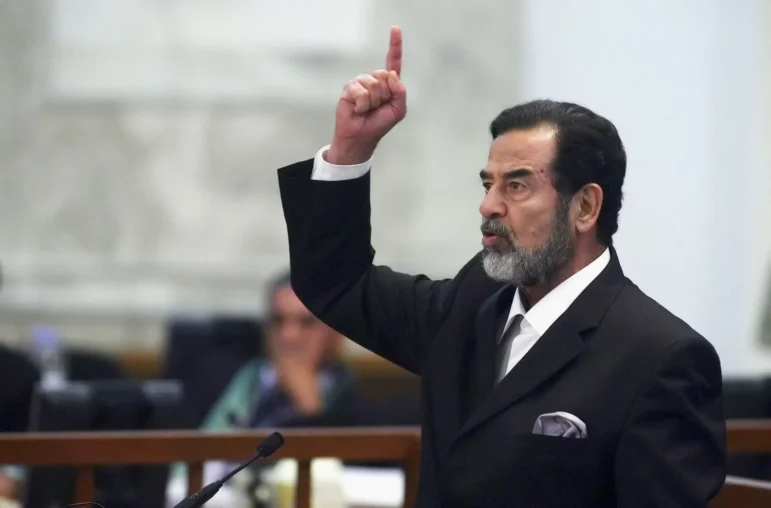
Saddam faced trial before the Iraqi Special Tribunal on charges of crimes against humanity, centered primarily on the killing of 148 Shiite residents in Dujail following an assassination attempt against him. The trial drew global attention, with supporters calling it politically motivated and critics insisting accountability was necessary.
Found guilty on November 5, 2006, Saddam was executed by hanging on December 30, 2006 — news that prompted starkly different reactions around the world, from celebration to mourning.
Political Legacy
Whether Saddam Hussein was a nationalist modernizer or a ruthless dictator remains one of the most debated questions in modern political history. Supporters point to national development, strong state institutions, and resistance to foreign influence; critics emphasize political repression, human rights violations, and the devastation of prolonged wars.
Most historians agree his legacy contains real elements of both — understanding him requires the full picture rather than a single narrative.
| Year | Event |
|---|---|
| 1937 | Born near Tikrit |
| 1959 | Participated in attempt against Qasim |
| 1968 | Ba’ath Party returns to power |
| 1979 | Becomes President of Iraq |
| 1980 | Begins Iran-Iraq War |
| 1990 | Invades Kuwait |
| 1991 | Gulf War |
| 2003 | U.S.-led invasion of Iraq; captured near Tikrit |
| 2006 | Executed |
The Bottom Line
Saddam Hussein’s journey from a poor village near Tikrit to Iraq’s presidency is remarkable on its own — but what keeps his story studied is the contradiction at its center: development alongside repression, loyalty alongside fear, projected strength alongside a nation ultimately devastated by conflict. His rise and fall remain a case study in the dangers of concentrated power and the limits of rule sustained through fear.
Frequently Asked Questions
How long was Saddam Hussein president of Iraq?
Saddam Hussein served as president from 1979 until 2003, making him one of Iraq’s longest-serving leaders.
Where was Saddam Hussein born?
He was born in Al-Awja, a village near Tikrit in Iraq.
What happened after Saddam Hussein was removed from power?
Iraq entered a period of political transition, conflict, and reconstruction. The years following his removal were marked by significant instability and efforts to establish a new political system.
Did Saddam Hussein modernize Iraq?
Many historians acknowledge that Iraq experienced significant modernization during the 1970s through investments in education, healthcare, and infrastructure. However, these achievements remain debated because they occurred alongside authoritarian governance.
Why is Saddam Hussein still studied today?
Researchers study Saddam Hussein because his leadership illustrates important lessons about power, dictatorship, nationalism, war, state-building, and international relations.
Contact
Available for contract work involving WordPress development, SEO/AEO, and digital marketing.
- LocationKhulna, Bangladesh
- Websitemahadi.moejja.com
- Platformmoejja.com
- WhatsAppMessage on WhatsApp