 Written by
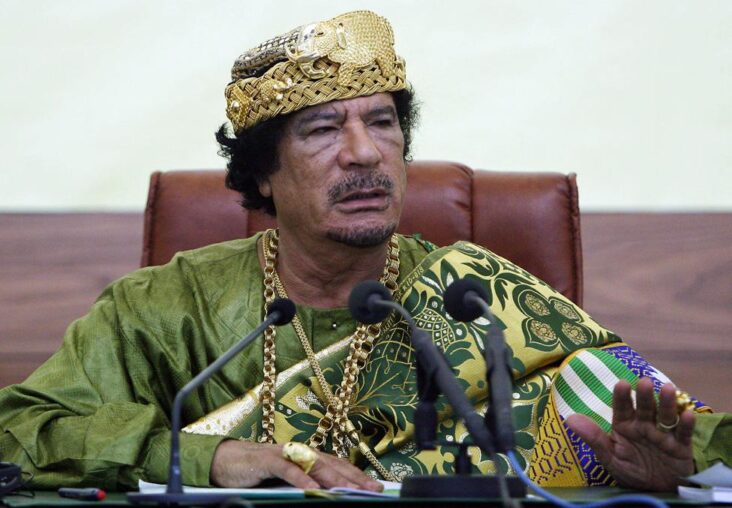
 Muammar Gaddafi: Ideology, the Jamahiriya, and a Contested Legacy
42 years in power, a political theory of his own invention, and a legacy still argued over from Tripoli to Karachi.
| Born | 1942, near Sirte, Libya |
|---|---|
| Ruled | 1969–2011 (42 years) |
| System | Jamahiriya — “state of the masses” |
| Ideology | Third Universal Theory, outlined in The Green Book |
| Died | Captured and killed near Sirte, October 2011 |
Who He Was
Muammar Muhammad Abu Minyar al-Gaddafi was born into a Bedouin family in 1942, coming of age as much of the Arab world underwent political transformation. As a young officer admiring Egyptian President Gamal Abdel Nasser, he became deeply drawn to Arab nationalism — and at just 27, led a bloodless military coup in 1969 that overthrew King Idris and ended Libya’s monarchy.
His Political Ideology
Gaddafi believed both Western capitalism and Soviet communism had failed humanity, and set out to build a “Third Universal Theory” combining Arab nationalism, socialism, anti-colonialism, direct democracy, and Islamic values. That theory became the foundation of The Green Book, published in the 1970s as his political manifesto.
The Green Book argued that political parties create division and that representative democracy is inherently flawed — if politicians make decisions for citizens, are citizens truly governing themselves? That question became the basis for Libya’s entire political experiment.
The Jamahiriya System
“Jamahiriya” translates roughly to “state of the masses” — in theory, citizens governed through local people’s committees and congresses rather than elected representatives. Supporters described it as more genuinely democratic than Western elections; critics argued it created the appearance of participation while real power stayed concentrated around Gaddafi and his inner circle.
Islam in His Politics
Islam was central to Gaddafi’s political identity, though his interpretation often diverged from traditional scholarship. He argued Islam could serve as a complete social and political framework — providing guidance for governance, demanding economic justice, and resisting foreign domination of Muslim nations — and frequently quoted the Quran in his speeches.
Tensions emerged regardless: many Islamic scholars disagreed with his interpretations, and he sometimes challenged established religious authorities directly. Libya recognized Islam as its religion and let Islamic values shape laws and public life, but it didn’t operate under classical Islamic jurisprudence — Gaddafi’s synthesis of Islamic principles, Arab nationalism, and revolutionary politics was genuinely his own.
Economic Development
Oil revenue during parts of his rule funded free education and healthcare, housing initiatives, infrastructure projects, and subsidized utilities — literacy rates improved significantly, and income levels became among the highest in Africa.
| Area | Reported Progress |
|---|---|
| Education | Significant expansion |
| Healthcare | Universal access programs |
| Housing | State-supported initiatives |
| Infrastructure | Large public investments |
| Literacy | Major improvement |
Economic statistics alone don’t tell the whole story, but they explain why some Libyans and outside observers remember aspects of his rule favorably.
Pan-African Politics
As years passed, Gaddafi shifted focus from Arab-centered politics toward African integration — supporting regional cooperation, continental institutions, and greater independence from Western powers. Many African leaders respected his push for regional unity; others criticized his methods and ambitions. Either way, his influence on African political discussions remains significant.
Why He Was Controversial
Supporters Point To
Economic development, resistance to foreign intervention, political independence, and social welfare programs.
Critics Point To
Restrictions on political opposition, human rights concerns, media control, and security crackdowns.
Multiple international organizations accused Libya’s government of suppressing dissent, and these criticisms intensified over the decades — understanding Gaddafi requires acknowledging both sides rather than ignoring either.
The 2011 Revolution
The Libyan Revolution emerged during the broader Arab Spring — protests escalated into armed conflict, NATO forces became involved, and by October 2011 Gaddafi had been captured and killed near Sirte, ending his 42-year rule.
Rather than the stable democratic transition many observers expected, Libya entered prolonged political fragmentation — competing governments, rising militia influence, and deteriorating security in many regions. Whether his removal created a necessary opening or a damaging power vacuum remains an active debate.
Lessons From His Legacy
1Political Independence Matters
His emphasis on sovereignty and resisting external domination still resonates with many.
2Economic Justice Remains Important
Distributing national wealth reflects long-standing concerns about social welfare and fairness.
3Accountability Cannot Be Ignored
Power concentrated for decades tends to create serious governance challenges.
4Ideology Alone Isn’t Enough
Even ambitious political theory has to function in practice — the gap between the two often decides success or failure.
The Bottom Line
Muammar Gaddafi remains one of the most debated figures of the modern Muslim world — a revolutionary to some, an authoritarian ruler to others. The truth sits closer to both narratives at once than to either alone, which is exactly what makes his story a lasting case study in leadership, sovereignty, and the gap between political vision and political reality.
Frequently Asked Questions
Was Muammar Gaddafi a socialist?
Gaddafi incorporated socialist ideas into his political philosophy, particularly regarding wealth distribution and state control of resources. However, he rejected both Western capitalism and Soviet communism, promoting his own “Third Universal Theory” as an alternative.
Was Gaddafi an Islamic leader?
Gaddafi considered himself an Islamic political leader and frequently referenced Islamic teachings. However, many scholars disagreed with aspects of his interpretations and political reforms.
Why is Gaddafi still popular among some Muslims?
Some Muslims admire Gaddafi for his anti-colonial stance, emphasis on political independence, support for social welfare programs, and criticism of foreign intervention in Muslim countries.
What was the Jamahiriya?
The Jamahiriya was Gaddafi’s political system based on direct popular participation through local committees and congresses. Supporters viewed it as participatory governance, while critics argued real power remained centralized.
What happened to Libya after Gaddafi?
Following Gaddafi’s fall in 2011, Libya experienced political instability, competing governments, militia conflicts, and economic challenges that continue to affect the country today.
Contact
Available for contract work involving WordPress development, SEO/AEO, and digital marketing.
- LocationKhulna, Bangladesh
- Websitemahadi.moejja.com
- Platformmoejja.com
- WhatsAppMessage on WhatsApp